
Straightening your teeth is a big decision. It affects how you look, how you eat, how you clean your teeth, and how often you visit the dentist. If you are weighing Invisalign against traditional braces, you are in good company. This is one of the most common questions we hear at Creekside Park Family & Cosmetic Dentistry.
There is no single right answer for everyone. The best choice depends on your bite, your lifestyle, your budget, and how much you care about keeping your treatment discreet. Below, Dr. Christopher Anton and Dr. Angela Anton break down the differences in plain terms so you can decide with confidence.
If you would like the full picture on Invisalign first, see our Invisalign Treatment page.
The Short Version
Here is a quick comparison before we go deeper.
| Feature | Invisalign | Traditional Braces |
|---|---|---|
| Appearance | Clear, nearly invisible | Metal brackets and wires |
| Removable | Yes, for eating and cleaning | No, fixed in place |
| Cleaning | Brush and floss normally | Extra tools needed around brackets |
| Food limits | None, since you remove them | Avoid sticky, hard, and crunchy foods |
| Office visits | About every 6 to 8 weeks | About every 4 to 6 weeks for tightening |
| Comfort | Smooth plastic, mild pressure | Wires and brackets can irritate |
| Best for | Many mild to moderate cases | Complex cases, severe bite issues |
| Discipline needed | High; must wear 20 to 22 hours a day | Low; you cannot forget them |
How They Work
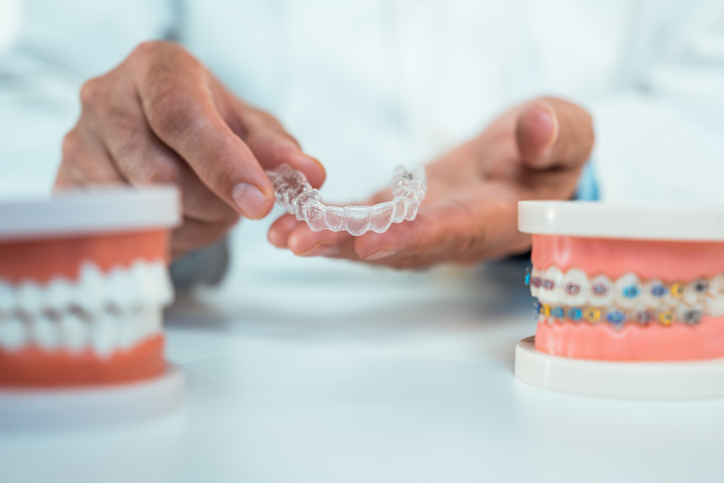
Invisalign uses a series of clear, custom-made plastic aligners. You wear each set for about one to two weeks, then switch to the next. Each set applies gentle pressure to move specific teeth a little at a time. The aligners are removable, so you take them out to eat, brush, and floss.
Traditional braces use metal brackets bonded to your teeth, connected by a wire. Your orthodontist or dentist tightens the wire on a schedule to gradually move your teeth. Braces stay in place the whole time. You cannot take them out.
Some patients also ask about ceramic braces, which work like metal braces but use tooth-colored brackets. They are less noticeable than metal braces, but they are still fixed in place and cost more. Clear braces are similar, using clear brackets and sometimes clear wires. At our office, we focus on Invisalign, and we will tell you honestly if a different approach makes more sense for your case.
Appearance and Confidence
This is often the reason patients choose Invisalign. The aligners are clear, and most people won’t notice you are wearing them. You can smile in photos, give a presentation at work, and go on a date without feeling self-conscious.
Braces are visible. That isn’t a dealbreaker for everyone, and plenty of adults wear braces happily. But if keeping your treatment private matters to you, Invisalign has a clear edge.
Eating and Drinking
With Invisalign, you take the aligners out before you eat or drink anything other than water. That means no food restrictions. Steak, apples, popcorn, and sticky candy are all fine. You just remove the aligners, eat, then brush and put them back in.
Braces come with food rules. Sticky foods like caramel and taffy can pull brackets loose. Hard foods like nuts and ice can break wires. Popcorn kernels can get stuck. You can still eat most things, but you have to be careful.
Cleaning Your Teeth
Invisalign makes oral hygiene easier. You brush and floss like you always have, with no brackets or wires in the way. Good hygiene matters during treatment because food trapped against your teeth can lead to cavities and gum problems.
Braces take more work. Food gets caught around brackets and under wires. You will need special brushes, floss threaders, and extra time to clean thoroughly. It is doable, but it takes more effort every day.
Comfort
Invisalign aligners are made of smooth plastic. There are no sharp edges or wires to poke your cheeks and gums. You may feel mild pressure or soreness for a day or two when you switch to a new set. Most patients describe it as a dull ache rather than sharp pain.
Braces can irritate the inside of your mouth, especially at first. Wires can poke, and brackets can rub. Your dentist will give you wax to help, but some adjustment is normal.
Office Visits and Your Schedule
Invisalign usually means check-in visits about every 6 to 8 weeks. These visits are quick. We check your progress and send you home with your next set of aligners.
Braces usually mean visits about every 4 to 6 weeks for tightening. Each visit may take a little longer, and you may feel sore for a day or two afterward.
Fewer visits can be a real advantage if you have a busy schedule or small children at home.
Discipline: The Big Difference
Invisalign only works if you wear the aligners. You need to keep them in for 20 to 22 hours a day. That means taking them out only to eat, drink anything other than water, and clean your teeth. If you forget them or leave them out too long, your teeth won’t move as planned, and your treatment may take longer.
Braces don’t depend on your willpower. They are fixed in place, so they work whether you think about them or not.
If you know yourself well enough to admit you might lose or forget aligners, braces may be the more reliable choice. There is no shame in that. The right treatment is the one that fits your habits.
Which Cases Each One Handles
Invisalign has come a long way. It can treat many mild-to-moderate cases, including crowding, spacing, overbites, underbites, and crossbites. Many adults and teens do great with it.
Traditional braces still have an edge for complex cases. Severe crowding, major bite problems, and cases that need significant tooth rotation may be better handled with braces. Sometimes a combination of treatments works best.
The only way to know for sure is an exam. Dr. Chris or Dr. Angela will look at your bite, your teeth, and your goals. They will tell you honestly whether Invisalign can get you the result you want, or whether braces are the better tool. If Invisalign isn’t right for you, we will say so.
Cost
Most dental insurance plans that cover orthodontics treat Invisalign and braces the same way. Coverage varies by plan, and our team will check your benefits and explain what is covered before you start.
We also offer flexible payment options to help you spread out the cost. You can learn more on our Payment and Insurance page.
So, Which Is Right for You?
Choose Invisalign if:
- You want a discreet option
- You are willing to wear aligners 20 to 22 hours a day
- You want to eat what you like and clean your teeth normally
- Your case is mild to moderate
Choose traditional braces if:
- Your case is complex or severe
- You would rather not rely on remembering to wear something
- You don’t mind visible brackets
- You want a fixed option that works around the clock
Many patients fall somewhere in the middle. That is exactly why a consultation helps.
Talk It Through With Dr. Chris or Dr. Angela
You don’t have to figure this out alone. At Creekside Park Family & Cosmetic Dentistry, Dr. Christopher Anton and Dr. Angela Anton will walk you through your options, answer your questions, and help you choose the path that fits your smile and your life.
Both doctors are Fellows of the American Academy of Clear Aligners and serve as Board Directors and Key Opinion Leaders for the organization. They have helped many patients in The Woodlands straighten their teeth with Invisalign, and they will be honest with you if braces are the better choice.
Ready to compare your options? Call us at 346-560-5916 or request an appointment online. We welcome patients from The Woodlands, Spring, Tomball, Conroe, Magnolia, Montgomery, and across Montgomery and Harris Counties.
For more details, see our Invisalign FAQs and our Clear Aligner Care Guide.